



Incumbent Teton County Commissioner facing Republican opponent
Published at | Updated at
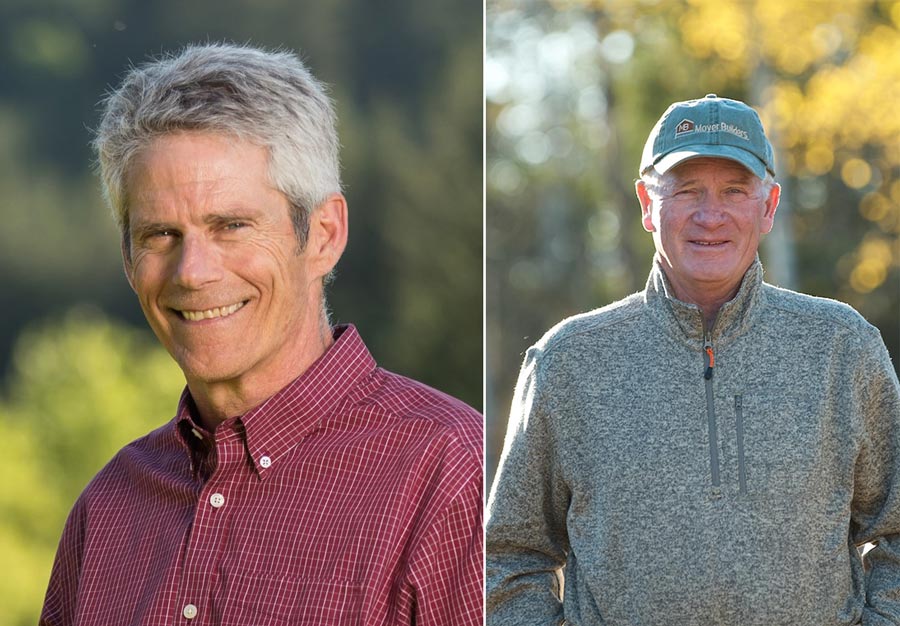
DRIGGS – Bob Heneage, the Democratic incumbent for Teton County Commissioner, is being challenged by Republican Pete Moyer in next month’s election for seat three.
EastIdahoNews.com sent the same eight questions to each candidate. Their responses, listed below, were required to be 250 words or less. Minor edits were made to meet the word count.
The general election is November 8.
Tell us about yourself — include information about your family, career, education, volunteer work and any prior experience in public office.
Heneage: I was born and raised in New England but have lived in the west since the 1970s and been an Idaho resident since 1985. My wife and I moved to Teton Valley from Boise with two small children in 1990.
After working more than 15 years in the construction trades, I decided working on residential projects was not enough. I wanted to contribute more to the community. In 1993, at the age of 37, I resolved to finish college and become an architect by enrolling at the University of Idaho. For a few years, monthly 600+ mile round trips from Moscow to Tetonia kept my family connected as much as possible. I finished my professional architecture degree in three and a half years, finishing first in my class. I graduated summa cum laude and was awarded the AIA Gold Medal, which is given to the top graduate at each US architecture school.
For 20 years practicing commercial architecture, I worked with many city councils, county commissions, and hospital and school boards. In community service, I was also a Driggs P&Z Commissioner, served on several non-profit boards and also served on the 2004 Teton County Comprehensive Plan project. I additionally served three terms as President of the Teton Valley Rotary Club.
Four years ago, following retirement from my career, I felt ready to take the next step of service to expand on the private, nonprofit, and public roles I have played over the years, and was elected to the Teton County Board of Commissioners.
Moyer: I was born in Kansas City, Missouri and raised in eastern Colorado in a farming and ranching community. My father and grandfather were farmers and ranchers who raised Hereford cattle and grew winter wheat. I worked on the farm driving tractors, trucks, and assist with harvests at the early age of 10. I also worked loading and unloading trucks and train cars for summer work and after school. My strong work ethic was molded at a young age.
After graduating from Cheyenne Wells High School, I attended Colorado State University then transferred to Parks College in Denver studying Computer Programing. To pay for my tuition and living expenses, I worked at Central Bank & Trust in Denver as a Computer Operator. It wasn’t much later that a friend offered me a job helping him remodel an old house in Steamboat Springs, Colorado. Since then, I have dedicated my career to the construction trade.
In 1966 I enlisted in the Colorado National Guard and served as a Medic for 6 years. I was honorably discharged in 1972. Service and teamwork are essential in the military.
I visited Teton Valley in late 1973 to do some skiing and fell in love with the small town atmosphere and the beautiful natural resources Teton Valley had to offer. In the spring of 1974, I moved to Teton Valley, purchased property, built a home, met my lovely wife, Melissa, to whom I have been married to for 46 years. We have 2 children and 4 grandchildren, all living in our beautiful Teton Valley.
What are your proudest accomplishments in your personal life or career?
Moyer: The ability to live, raise a family, have children, grandchildren all living in this amazing Teton Valley.
Heneage: Following five years commuting over Teton Pass, I opened an office for Wyoming’s Plan One Architects in Driggs in 2002. Our office employed eight full time staff and served a mostly public sector market encompassing a 350-mile radius. I was responsible for coordinating design teams of up to 25 professionals on large, complex projects throughout Idaho and Wyoming, with budgets of up to $48 million. Private public partnership was a cornerstone of our business. This skill set has been directly applicable to my responsibilities as a County Commissioner.
Examples of our professional contributions to the county include Teton County Courthouse, Driggs City Center, Teton Middle School, US Bank branches in Driggs and Victor, the Teton Geo Center, and renovations and additions to Teton High School. We also developed major regional projects such as the Idaho National Laboratory’s Energy Innovation and Energy Systems Laboratories in Idaho Falls. Our office received awards from Engineering News Record for the Best Project in the Intermountain Area and the Best Green Project in the United States for INL’s EIL project.
As a Commissioner, I made a priority from the start of my term to see the county’s Land Development Code updated. Following three years of work and three public hearings, the new LDC was completed and adopted by the BoCC in July 2022. I am currently the county’s representative on the boards of the Teton Regional Economic Coalition, the Driggs Urban Renewal Agency and the Five County Treatment and Youth Rehabilitation Center.
Why are you a member of the Republican / Democrat / Independent / Other party? Briefly explain your political platform.
Heneage: I support the vision and values of the Teton County Democratic Party, which includes residents working together across cultural and political divides for the well-being of the community.
The TCDP envisions a predominantly rural Teton Valley where development is focused around existing towns, and where agricultural lands and wildlife habitats are sustained as open space. We believe in protecting what makes Teton Valley special for future generations through stewardship of our agricultural, environmental, and cultural heritage. We believe we must balance individual freedoms with the common good of our community.
My political platform has two major pieces — planning for our future and embodying solid principles.
Planning for our Future: a) The commissioners worked hard to turn the county’s Comprehensive Plan into actual policy. The new LDC is the fulfillment of a promise ― we finished what we started. b) We need to diversify our economy. We need more businesses who employ locals and build the economy without depending on the up-and-down real estate cycle. c) We must preserve our rural character.
Embodying Solid Principles. a) I was raised with the values of hard work and thrift. I care deeply about clean air, clean water and clean energy. I believe in preserving the integrity of our public lands. My basic nature is that of a problem solver and project manager. b) I believe in evidence-based decision making. County services should be based on facts and figures, not sweetheart deals and personal bias. c) I have committed fully to my role as County Commissioner.
Moyer: I am a Conservative Republican. I was a Democrat for 48 years. I switched parties in 2012 and became a registered Republican. Long before switching to the Republican Party, I found my self in conflict with many of the Democrat Party Policies. I’ve always believed that a major guiding principle should be privacy in one’s home or place of work from unwarranted or unreasonable intrusions by the government, ownership, and use of private property for personal benefit as stated in the constitution.
Political Platform:
Land Development code: Infringement on property rights. The Land Development code should have been on the November ballot for approval by the voters and not decided by a select few.
County Efficiency: More focus on Infrastructure. Roads, bridge, transportation, etc. Assure that the Sheriff’s department is adequately funded and the hiring of additional personnel. Streamline the Building department to assure the timely processing of building permits.
Representing the District as Commissioner of District 3: Fully represent the residents of District 3 and the citizens of Teton County.
Housing: I believe the County should encourage accessory housing and possibly identify areas in the county they could possibly be zoned for multi-family housing.
What are the greatest challenges facing residents in your county?
Moyer: Adequate housing, both affordable and housing inventories for our growing population. Understaffed and underpaid Sheriff’s department and Road and Bridge Department.
Heneage: The four greatest challenges facing the county today are all derived from the current explosive growth we are facing every day. First, people are still concerned about unplanned land development. This has partially been addressed through the new land use code, but the pace of growth in the valley remains quite volatile.
Next, folks are worried about the potential effects of Grand Targhee’s expansion plans. Primary amongst those concerns are the fact that most expansion-related revenue will flow to Wyoming, while most support burdens―transportation, emergency services, affordable housing, etc.―will be placed on Teton County Idaho taxpayers.
Third, Highway 33 traffic has ramped up over the past two years to the point where it frequently feels dangerous to drive. Considerations include the need for turn lanes at major intersections, breakdown lanes and the installation of rumble strips to alert drivers when they are drifting out of their lanes. Negotiations between the county, cities and ITD are planned to commence this fall.
Fourth but most important of all is affordable housing―how to encourage it, how to fund it, and how to see it through to ultimate occupancy. In 2019, the county and the cities of Driggs, Victor and Tetonia together formed the Teton County Joint Housing Authority. The county and the cities are actively working with the Housing Authority by donating land and significant funds to kickstart projects. Several projects are underway but more are needed and the Housing Authority needs ongoing support from the Board of County Commissioners.
How will you best represent the views of your constituents – even those with differing political views?
Heneage: The county has had to conduct its business in an ever more challenging and, at times, disrespectful environment for public officials and employees. In many ways, the county seems to be politically and philosophically divided in similar fashion to what we see on the national stage. It really doesn’t have to be that way. I promise to listen and to remain open to other views and try to develop solutions that work for as wide a spectrum of people as possible.
I believe we’re “all in this together.” I value the friendship and opinions of old-timers and newcomers alike. I enjoy synthesizing the diversity of opinions and using my experience as a large project manager to develop solutions that work for the entire community and help us prepare and adapt for the future. We all benefit from fair and consistent government and a strong economy. And I think we all hope to preserve the rural character of Teton Valley. Mutual respect and community support are the things that bind us together and make our valley a great place to live.
Moyer: The number one priority of a County Commissioner is to listen to his constituents no mater what their different political viewpoints might be.
What are your goals while in office? Are there any specific projects or issues that are important to you?
Moyer: As I stated above, adequate affordable housing is high priority. The use of accessory housing as a tool to encourage existing lot owners to invest in an accessory building for rental purposes to alleviate our lack of housing issues. I want to find out more about the newly formed Teton County Housing Authority. In commercial and industrial zones, we want to make additional mechanisms to allow for additional onsite employee housing in these areas.
Heneage: Land use planning in Teton County is still a big issue. New development must be funded by the developer. It is wrong to socialize risk while privatizing profit. We have finally seen our adopted Comprehensive Plan properly worked into the County Development Code, so we have clear guidelines for future decision making.
I am working to diversify the economic base of the County, by attracting new businesses that in turn create quality jobs. We have attracted more clean industries ― Give’r Gloves and New West KnifeWorks among others. These are examples of forward-looking enterprises that conduct business over a wide area yet employ most of their staff locally and recirculate their payrolls through the local economy. The factors that induced these great companies to set up operations here, such as quality schools and a recreational lifestyle, can surely draw in more businesses.
The BoCC is committed to ongoing funding and support of the Joint Housing Authority. The JHA currently has projects underway on Depot St in Driggs and at Sherman Park in Victor and is well on its way to delivering dozens of deed-restricted units to people who qualify for them. The JHA has entered into agreements with Teton County and the cities of Victor and Driggs to use publicly owned parcels for housing developments that prioritize employees who work in our community. Ongoing support and funding of the most viable housing mitigation entity we have is absolutely essential.
Do you have any plans to significantly reduce or expand staffing or make changes to the county budget if elected? Are there areas that need more funding or areas where cutbacks could be made?
Heneage: Teton County, like other local governments and similar organizations, is facing a staffing shortage that is proving quite challenging. The county is working with an HR consultant and headhunter to address our current staffing issues. There is no plan at present to expand staffing beyond filling the many empty positions we now have.
The worst staffing crisis is in sheriff’s dispatch, where we are drastically understaffed. We have instituted pay raises that place our dispatchers as the 2nd highest paid in the state for hourly wage, and we’ve also instituted a $1500 signing bonus for these positions, but we continue to grapple with the hiring impediment of an unrealistically high cost of housing. We have begun talks with neighboring counties to develop a regional dispatch center that can handle emergency calls for a much larger area. In the longer run, we believe a regional dispatch center will be a better solution for both the member counties and the dispatchers who staff it.
The county’s budget is always stretched to the limit and, considering statutory limits on tax increases, will likely remain that way for the foreseeable future. Our ability to address fundamental county obligations like Road & Bridge and snow plowing has been supplemented for the past decade by a voter-supported annual levy—currently $1.3M per year. Over the past 17 years the voters also approved bonds for two elementary schools and a new middle school, so there’s likely not much public appetite to take on more at this time.
Moyer: I have recently been looking into the budget numbers and do have questions about some of the spending and if the county is getting good results from the money being spent. The sheriff’s department is one area where their should be increases in the budget.
As an elected official how will you work with the media to disseminate important information to the public?
Moyer: It is very important to have a good, open, transparent, relationship with the media. In this way, the public will be able to get honest firsthand information and the ability to stay informed on the issues.
Heneage: An open line of communication to the media is critical to delivering good public service. My email address and cell phone number are both readily available through Teton County’s website. Any member of the press may reach out to me at any time and many do on a regular basis. The county’s Emergency Services Manager, County Manager, our other elected officials, and department heads all have open lines of communication with the media as well.
During the pandemic that began in 2020, an ongoing connection to the media was imperative to successful situational management. I and the other elected leaders also had to plot a course through layers of federal and state regulations (and lack thereof) with all that it brought to the valley and its citizens. By all measures, Teton County achieved a lower hospitalization and death rate from the Covid-19 virus than most counties across the state and region.